Archive for the ‘breadboard’ tag
Constructing an arduino on a breadboard
Why should we build an Arduino platform on breadboard?
A simple answer is: why not?
This is far away to be an idiot answer, because sometimes people wants to take account into electronics but doesn’t know where to start from.
Differently from a pure theoretic book, the practice is a continuous discover of our potentialities.
Very few people has the ability to see in mind what a theory can onto the matter, while the opposite path is more widely available.
The strength of a good practical spirit is the ability to better understand the theory!
So… why not?
Liquid Filling Machine – Liquid Filler Part 2
In the first part of liquid filler we have made the user interface.
LCD buttons and circular menu were made.
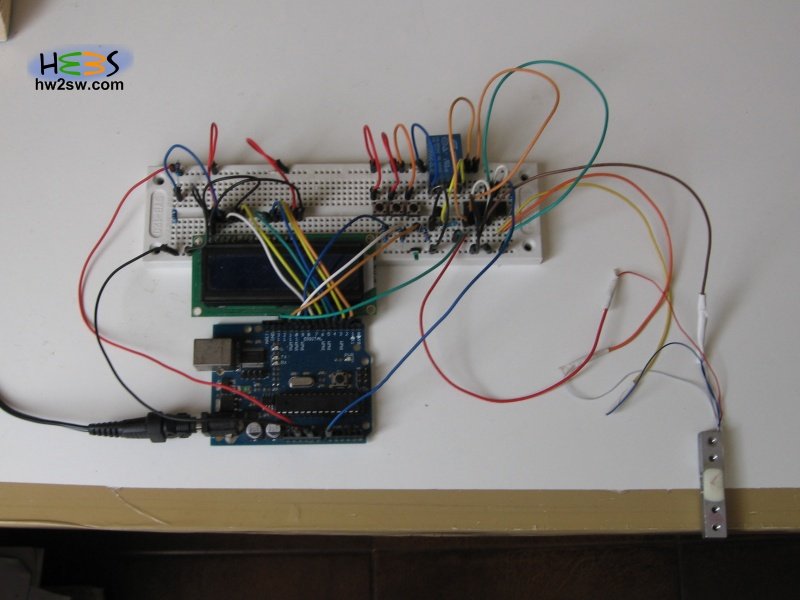
Now it is time to add the relay and the weight sensor.
We will keep working on our breadboard.
In this article we will see how to connect the relay then our load cell amplified by the INA125 and lastly the modified code from the last time.
It is highly recommended to read the relay article and the weight sensors introduction before you start.
Manual and Automatic Traffic Lights
And something else, which we’ll start with before trying to regulate our traffic.
We’ll use LEDs (Light Emitting Diode): 1 red, 1 yellow and… ?!?!
yes, 1 green.
In the first part every LED will be gradually turned from off to on and viceversa.
After that, the traffic lights: just one LED on.
We need following stuff:
Read the rest of this entry »
Breadboard
Breadboard is an important tool for electronic circuits prototyping, it gives you possibility to easily interconnect and test components you need before any other superior step like translating everything directly on a copper clad circuit/laminate board; and it’s reusable for a long time.
Capacitor on breadboard
One classical example to take confidence in electronic circuits is related to charging/discharging capacitors (symbol: C).
These components are able to catch electrical charges and to keep them for a long time; theoretically for an infinite one, but this is impossible, first of all because of Joule effect (heat dissipation to the ambient with slow progressive energy loosing).